Modern arcades are no longer powered by quarters. They’re powered by systems.
For years, small arcade and route-based amusement operators have managed locations machine by machine. A card reader here. A cash box there. Separate reports. Separate reconciliations. It’s tedious and time consuming work,
And as soon as you want to grow beyond a few machines, the operational cracks start to show. More swipes mean more processing events. More machines mean more reconciliation. And more foot traffic means higher expectations from players who want to tap, reload, and keep playing without interruption.
That’s why many operators are rethinking not just whether to go cashless — but how their entire arcade payment structure is designed.
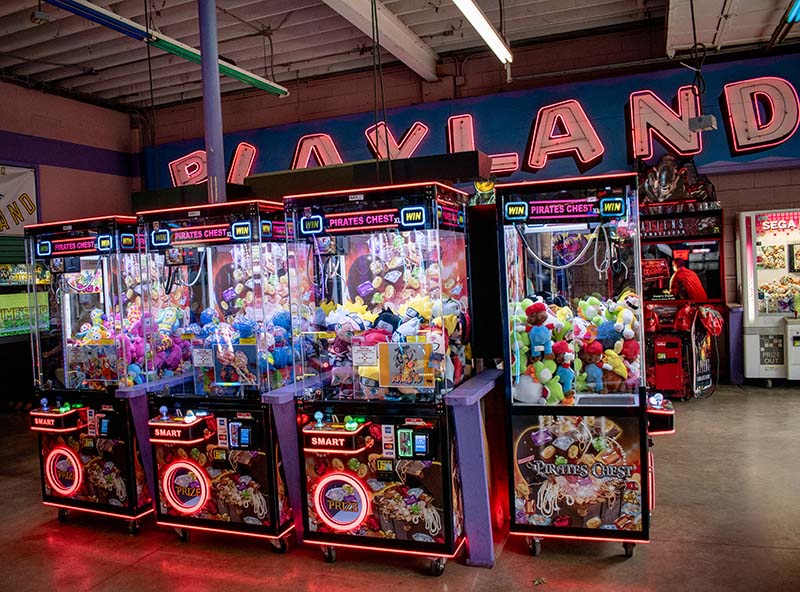
The revenue case for modern arcade payments
The move toward more integrated systems starts with a simple reality: cashless changes behavior.
According to Cantaloupe’s data, cashless amusement transactions averaged $6.01 per play, compared to just $0.94 for cash — a 539% difference. Even though only 37% of amusement transactions were cashless, they accounted for 79% of total sales volume.
Those numbers don’t just suggest convenience. They suggest a fundamental shift in how people engage with games. When players aren’t limited by the cash in their pocket, they stay longer and play more.
But while adding standalone card readers unlocks that higher spending potential, it doesn’t automatically solve the operational side of running a multi-machine location.
When “cashless” isn’t enough
Installing individual card readers on machines is often the first step toward modernization. For operators with a few games scattered across different locations, that approach makes sense. It’s flexible. It’s simple. It increases revenue potential quickly.
However, when machines are clustered in one place — restaurant, hotel, or apartment recreation space — each tap can trigger its own processing fee. In environments where players swipe repeatedly across multiple games, those fees accumulate quickly.
At that point, the question shifts from “Should I go cashless?” to “Is there a smarter way to structure payments?”
That’s where an all-in-one arcade system enters the conversation.
What an integrated arcade system actually does
An integrated arcade payment system doesn’t treat each machine as an island. Instead, it treats the entire location as one connected ecosystem.
That card works across all connected machines. Behind the scenes, transactions are batched instead of processed one by one.
This shift changes the economics of the location. It reduces the number of processing events. It simplifies reconciliation. And it centralizes oversight into one platform.
Instead of managing machines individually, operators manage the location as a whole.
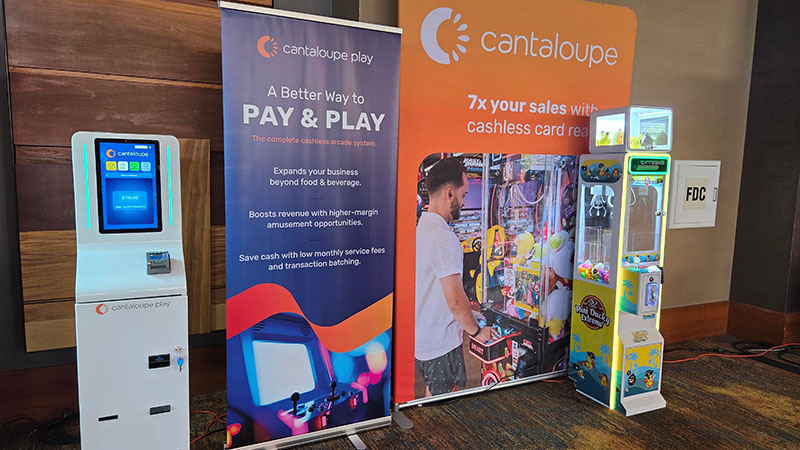
How Cantaloupe Play was built for this model
Cantaloupe Play was designed specifically for small-to-mid-sized arcade environments — particularly those operating up to 50 machines in a single location.
At the center is a self-service kiosk that dispenses and reloads Play Cards. That kiosk can connect to up to 50 Engage Lite card readers and holds up to 450 Play Cards for distribution. Players can load funds using cash, credit, or mobile wallet, and in many cases, reload remotely.
The operational advantage lies in transaction batching. Rather than charging a processing fee for every individual tap, Cantaloupe Play batches multiple plays from the same customer card into a single transaction (up to a set limit). In environments where customers move from game to game, that structure can significantly reduce the total number of processing fees over time.
All activity flows into modern management tools that provide detailed reporting, remote visibility, and less manual oversight. That means centralized reporting, remote visibility, and less manual oversight.
It’s not built for massive family entertainment centers with redemption counters and hundreds of games. It’s built for operators who want a cohesive system for small, unattended, or route-based arcade environments.
The bigger industry shift
The growth in amusement and gaming isn’t just about adding more machines. Sales grew by 16.9% in 2025. Operators who continue treating machines independently may see revenue increases from cashless adoption. But operators who rethink the entire payment ecosystem can streamline operations at the same time.
That’s the real evolution happening in amusements. Not just cashless — but connected.
As self-service entertainment continues to modernize, the conversation is moving beyond “Should I add a reader?” to “How should this entire location operate?”
For operators managing more than a few machines in one space, that shift from standalone devices to an integrated system can redefine both the player experience and the operational model behind it.
Because long-term growth isn’t just about adding more games. It’s about building a smarter foundation to support them.
Fast Facts
-
Cashless players spend more, with average amusement transactions at $6.01 vs. $0.94 for cash.
-
Even though only 37% of plays are cashless, they generate 79% of total amusement sales volume.
-
Integrated arcade systems batch transactions, helping operators reduce processing fees across multiple games.
-
Cantaloupe Play connects up to 50 machines, letting operators manage an entire location from one system.